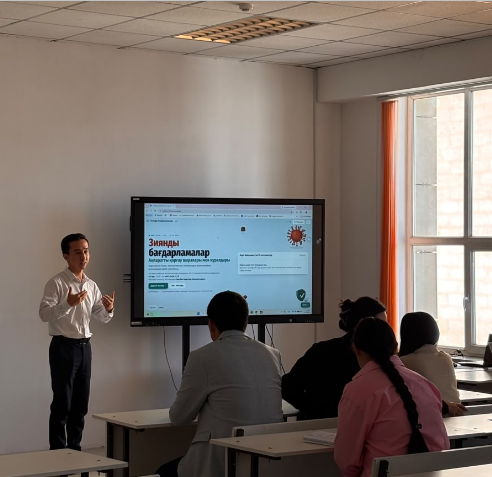
AN OPEN LESSON ON PROTECTING INFORMATION FROM MALWARE WAS HELD AT ZH.A. TASHENEV UNIVERSITY
2026-10-21
Open Lesson Held in “Information and Communication Technologies”
Instructor: Nurislam Kuatbek, Master’s Degree Holder, Senior Lecturer
Topic: “Malware: Information Protection Measures and Tools”
On October 21, 2026, Nurislam Kuatbek, Master’s Degree Holder and Senior Lecturer, conducted an open lecture for students of groups 4201-25k10, 4201-25k11, and 4201-25k12 as part of the course “Information and Communication Technologies.” The topic of the lesson was “Malware: Information Protection Measures and Tools.”
The aim of the lesson was to provide students with a basic understanding of malware, its types, methods of distribution, and harmful effects on information systems. Particular attention was given to organizational, software-based, and technical information protection measures, as well as to developing skills in the proper use of antivirus software and safe Internet practices.During the lesson, students explored the characteristics of computer viruses, worms, Trojans, spyware, adware, and ransomware. They also examined how malware spreads through email attachments, fake websites, suspicious links, unverified software, and external storage devices. The signs of phishing and social engineering were discussed, along with the principles of creating strong passwords, using two-factor authentication, backing up data, and working with antivirus software.
The lecture was delivered in a presentation-based, informative, and interactive format using modern teaching methods. Students actively participated in group activities, analyzed practical information-security scenarios, and proposed appropriate courses of action in response to digital threats. At the end of the lesson, their understanding of the topic was assessed through an online test.
The open lesson was conducted at a high organizational level. Its content and structure were fully aligned with the stated objectives and contributed to developing students’ ability to identify information threats, distinguish between different types of malware, and make appropriate decisions to protect their personal and academic information.