Educational Tour
2026-05-04
Journey to the Foothills of Turkestan: An Educational Tour for Geographers and Historians
April 30, 2026, Senior Lecturer of Zhumabek Akhmetovich Tashenev University, Zh.D. Sherimbaeva, Senior Lecturer N.T. Saparova, Master of Science, Lecturer N.M. Mominkul, Master of Science, Lecturer F.K. Alaydar organized an educational tour entitled "Journey to the Foothills of Turkestan." Students from groups EP-25-2k and EP-25-3k participated in the tour, which combined local folklore and history for young people.
Local folklore and geography are a major training ground for future specialists in geography and history. Recently, together with young students studying this dual major at our university, we organized an educational trip from Shymkent to the gem of the Tole-Bi region—the Kaskasu Gorge. This trip wasn't just a vacation, but a true scientific field expedition to observe and appreciate the region's geomorphology, hydrology, and rich history.
1. Departure: From Shymkent to Sairam
Our route began southeast of Shymkent. Upon reaching the outskirts of the city, the students were given geographical information about one of the region's main waterways—the Badam River. They discussed the Badam River basin, a left tributary of the Arys River, and its role in the regional economy.
Soon, our car passed the ancient village of Ispidzhab—present-day Sairam. For the history students, it was like a veritable open-air museum. The history of the founding of this ancient city, one of the centers of Islam in Central Asia and located on the Great Silk Road, was presented, along with historical information about medieval architectural monuments and mausoleums.
2. Meeting in the village of Koksayak (Georgievka) and the Old Church
Our next stop was the village of Koksayak (formerly Georgievka), one of the largest settlements in the Tole-Binsky district. Here, the first important news of our journey awaited us. The village was founded in the late 19th and early 20th centuries, during the period of Tsarist Russia's resettlement policy. A striking testimony to this historical period is the ancient Orthodox church in the village (St. George's Church).
When we stopped at this historic building and entered, we were warmly greeted by the priest and nuns who worked there. They shared valuable information with the students about the building from the time its foundation was laid, its fate during the Soviet period, and how it has survived to this day. While the history students focused on the building's architectural features, the geography students analyzed how these settlement processes influenced the region's demographics.
3. The Intersection of Art and History: Art Gallery
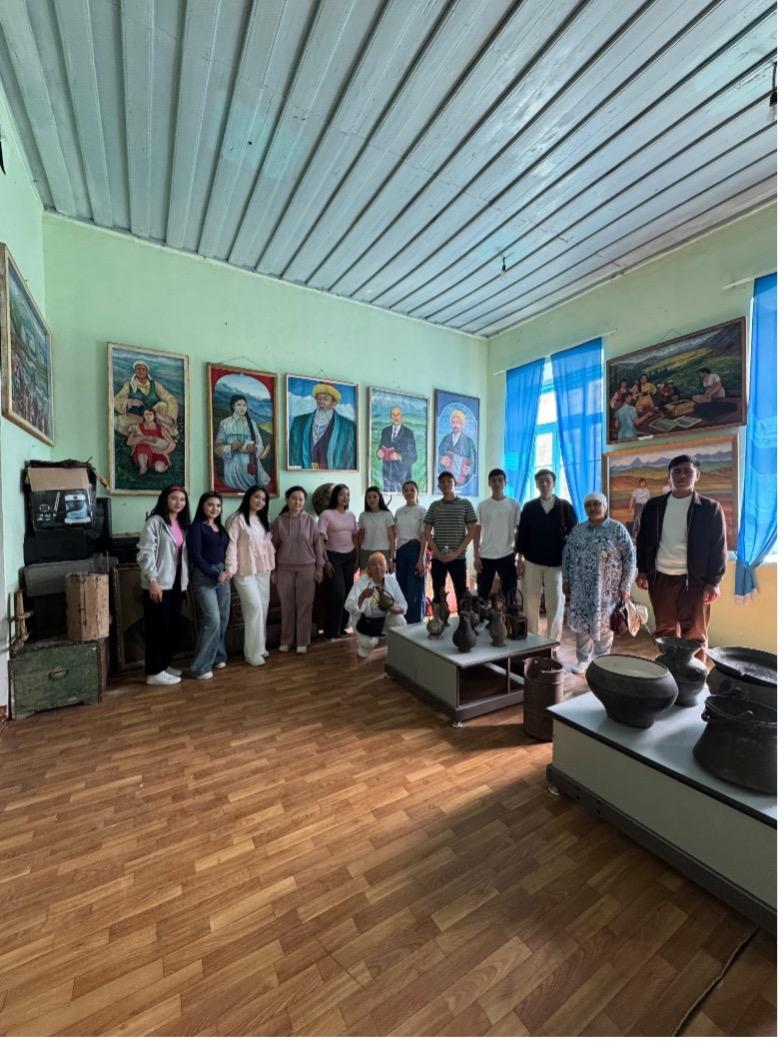
After leaving Koksayak, we headed to the Art Gallery (Tole-Bi Regional Art Center/Museum) located in the village of Tasarik. Here, the students explored the works of local and national artists depicting the beautiful natural beauty of the Tole-Bi and Kaskasu regions. After hearing fascinating information about the gallery's history and the significance of the paintings on display, the students took commemorative photographs in front of the works of art. Seeing how the beauty of nature is reflected in art enriched the aesthetic sensibilities of both geographers and historians.
4. Villages near Lengir and on the Mountain Slopes
Our journey continued, taking us past the town of Lengir. The students learned about how Lengir developed as a brown coal mining center in the last century and the history of its city status. The journey then continued up a mountain gorge. We traveled along the Sairamsu River, a major tributary of the Arys, one of the main rivers of southern Kazakhstan, and focused on the history and geography of small villages such as Dostyk, Akaidar, and Sungat at the foot of the mountain. We discussed the adaptation of these villages to the natural landscape and their potential for livestock farming and ecotourism.
5. Kaskasu: Rest and Recuperation
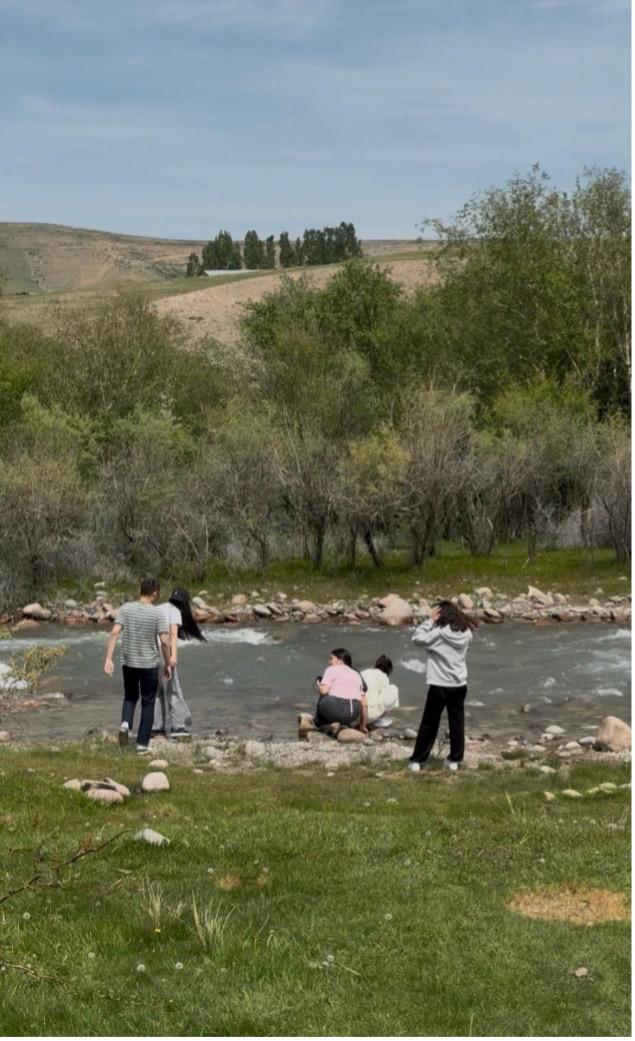
We also arrived at the long-awaited main destination – Lower Kaskasu and the village of Kaskasu. Here, along the clean and cool Kaskasu River, which flows down the mountain with a ringing sound, the students rested and relieved the fatigue of their journey. The fresh mountain air, the sound of falling water, and the greenery gave the young people a special boost of energy. Geographers studied the riverbed and cliffs, focusing on hydrological parameters, while historians exchanged opinions on the ancient tribes and settlements in the region.
6. The Legendary Kyryk Kyz Rock
The most impressive and final part of our trip was a visit to the famous Kyryk Kyz Rock near Kaskasu. The complex of unique geomorphological forms—sculptures seemingly carved from stone by nature itself—could not fail to amaze the students.
Here, in addition to explaining the process of geographic formation of this natural monument (the erosive effects of wind and water), we delved into its profound historical and legendary background. During the early days of a Kazakh legend tells of a forty-year-old girl who turned into stone to escape an enemy and preserve her honor. A sacred legend about the lake was recounted. The students were amazed by the mysterious nature of this place and realized how closely history and geography are intertwined. We took group and individual photos of this beautiful place and gained spiritual fulfillment.
Conclusion
On the way back to Shymkent, the students shared their impressions and were in excellent spirits. This trip was an invaluable practical lesson, demonstrating how theoretical knowledge from books connects with real life in the field, and history connects with nature. The information gained and the photographs taken will provide an excellent basis for future research papers, essays, and creative projects.